Crush It Down: The Producers Destroying Audio Quality on Purpose — and Making Hits
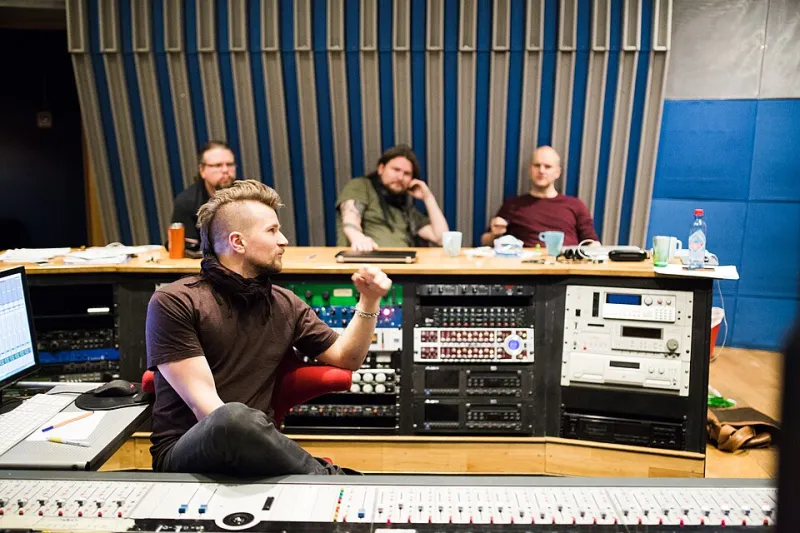
Photo: The Smiler (band), CC BY 2.0, via Wikimedia Commons
Let's start with something that would have gotten you laughed out of a recording studio twenty years ago: the idea that you might deliberately reduce the quality of your audio. Not as a last resort, not because you couldn't afford better gear — but as the whole point. As the creative decision that makes the track.
Welcome to 2024, where bit-crushing, tape saturation, vinyl simulation, and intentional degradation are standard tools in the arsenal of producers working across hip-hop, indie, R&B, and pretty much every genre with a pulse. The question isn't really why anymore. The question is how we got here, what it actually sounds like under the hood, and why it hits so different from the clinical perfection that dominated production for most of the digital era.
What Bitcrushing Actually Does (And Why It Feels Good)
Quick technical sidebar, because it matters: bitcrushing is the process of reducing the bit depth and/or sample rate of an audio signal. Standard digital audio runs at 16 or 24 bits, 44.1kHz or higher. When you crush that down — say, to 8-bit depth at 11kHz — the audio loses resolution. You get quantization noise, aliasing, a grainy, crunchy texture that sounds like the signal is straining against its container.
That sound, technically a form of distortion, is also the sound of early samplers, cheap drum machines, lo-fi cassette recordings, and the entire sonic world of late-'80s and early-'90s hip-hop production. When producers like J Dilla were chopping dusty soul records on an MPC with limited sample memory, the bitcrushing wasn't a choice — it was a constraint. But the music that came out of those constraints had a warmth, a texture, an emotional weight that pristine digital production often struggles to replicate.
Human ears, it turns out, have complicated feelings about imperfection. We've been trained by decades of acoustic music to associate certain kinds of harmonic distortion with warmth and presence. Tape saturation does it. Vinyl surface noise does it. A bitcrushed drum loop does it. The signal is degraded, technically. Emotionally, something different is happening.
The City Pop Thread and the Vaporwave Rabbit Hole
You can't talk about lo-fi aesthetics in American music without following the thread back through vaporwave, and you can't talk about vaporwave without landing in Japanese city pop. This is where the Mikunigaoka Fuzz perspective gets particularly relevant.
City pop — the lush, funky, sophisticated Japanese pop sound of the late '70s and '80s, artists like Tatsuro Yamashita, Mariya Takeuchi, Anri — was recorded with high production values for its time. But when those records started circulating on YouTube and Soundcloud in the early 2010s, often ripped from vinyl or cassette, they arrived with a patina of age. Tape hiss. Slight pitch instability. The warmth of analog degradation.
Vaporwave producers heard that and did something interesting: they slowed it down further, pitched it lower, added more artifacts, chopped it into loops. They weren't just sampling city pop — they were processing it through a aesthetic philosophy that treated degradation as enhancement. The result was something that sounded like a memory of music rather than music itself. Nostalgic for a time many listeners had never actually lived through.
That emotional trick — the fake nostalgia, the manufactured warmth — turned out to have enormous reach. Lo-fi hip-hop study playlists on YouTube accumulated hundreds of millions of plays. The aesthetic jumped from Soundcloud to Spotify to mainstream production conversations almost overnight.
The Producers Making It Work Right Now
Producers like Kenny Beats, Pi'erre Bourne, and Shlohmo occupy different corners of the lo-fi production world but share a willingness to let things sound imperfect in deliberate ways. Bourne's work with Playboi Carti leans into a woozy, unstable quality — drums that feel slightly wrong, melodies that blur at the edges — that creates a genuinely disorienting emotional space. It shouldn't feel good. It does.
In indie, producers like Alex G (who produces his own records) and Caroline Polachek's collaborators have been working with tape effects, deliberate distortion, and audio that sounds like it's being transmitted through something fragile. The signal is always slightly in danger of falling apart. That fragility is the feeling.
On the underground side, the Bandcamp ecosystem is full of producers who've built entire careers on lo-fi aesthetics — artists who record into cheap interfaces, deliberately limit their sample rate, process everything through virtual tape machines and vinyl simulators. The interesting thing is that these records often sound more expensive in terms of emotional impact than records made with six-figure studio budgets, precisely because the imperfections create intimacy.
The Psychology of the Degraded Signal
There's a reason people buy vinyl in an era when they could stream lossless audio for free. There's a reason cassette sales have made a genuine, non-ironic comeback. There's a reason that lo-fi, by definition the lower quality option, keeps winning emotional arguments against hi-fi.
Part of it is tactile — physical media has a relationship with the body that streaming doesn't. But part of it is genuinely sonic. Imperfect audio carries information that perfect audio doesn't. It carries the history of its production. A cassette tape hiss tells you something happened in a room, at a time, with equipment that had limits. A bitcrushed sample tells you someone made decisions inside constraints. That contextual information reads as authenticity, even when it's manufactured.
In an era when listeners are increasingly sophisticated about how music gets made — when production techniques get discussed on TikTok, when people know what a compressor does — the choice to degrade sound reads as a statement. It says: we're not trying to fool you with perfection. We're showing you the grain of the wood.
The Fuzz Is the Feature
Mikunigaoka Fuzz exists in this exact space — the idea that distortion isn't a problem to solve but a quality to explore. The noise in the signal. The beauty in the broken.
Lo-fi production in hip-hop and indie isn't a trend in the sense of something that will pass. It's a correction. After decades of digital production chasing a kind of sonic cleanliness that turned out to be emotionally sterile, the fuzz is back. The crunch is back. The tape wobble and the vinyl pop and the bitcrushed drum that sounds like it's being played through a phone from 1994.
Crush it down far enough, and something real comes through. That's the whole idea.