Red Line Religion: The Producers Treating Gear Damage as a Sacred Act
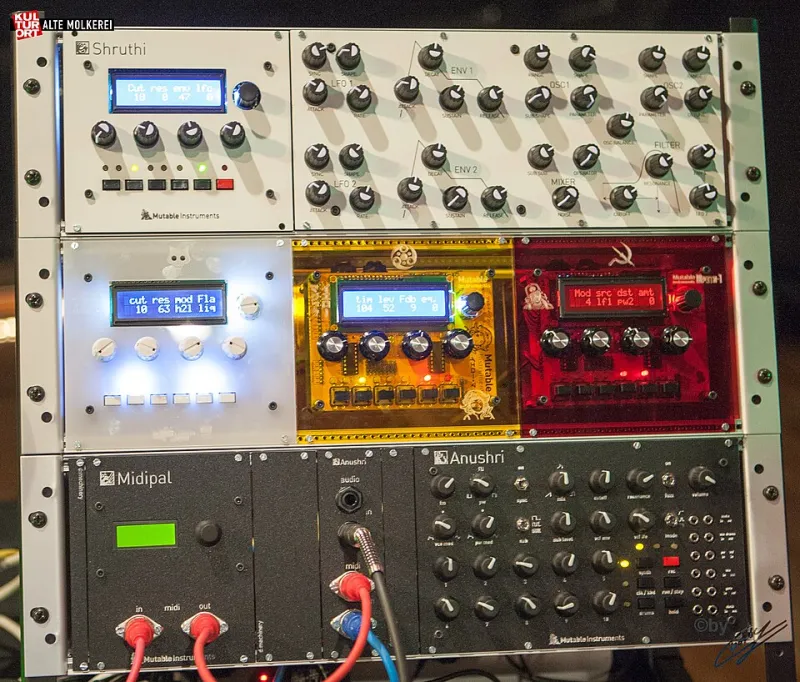
Photo: byCharly, CC BY 2.0, via Wikimedia Commons
Somewhere in a Bushwick loft, a synthesizer is screaming. Not malfunctioning — screaming intentionally. The person behind the keys is pushing gain stages past what the manual recommends, watching the meters pin red, and grinning. This is not a rookie mistake. This is the whole point.
A quiet but passionate corner of electronic music production has turned gear abuse into a philosophy. Producers are deliberately overdriving synthesizers, running signal chains too hot, and coaxing harmonic distortion out of hardware that costs more than most people's rent. The results are textures that feel physically warm, almost violent — the kind of sound you feel in your sternum before your ears fully process it.
Why Clean Sounds So Cold
Digital audio production spent decades chasing transparency. The whole pitch of modern recording technology was fidelity: capture what's really there, with nothing added, nothing colored. And it worked. Today's home studios can produce recordings that are technically flawless — flat frequency response, near-zero noise floor, dynamic range that would've seemed like science fiction in 1985.
But here's the problem. That technical perfection has a texture too, and that texture is glass. Smooth, clear, cold. A lot of listeners feel it even if they can't name it — that sense that a record sounds finished but not alive.
Saturation is the antidote. When you push an analog circuit past its comfortable operating range, the signal starts to clip. But unlike harsh digital clipping, analog circuits clip softly, rounding off transients and generating harmonic overtones — mostly even-order harmonics that sit in mathematically pleasing relationships to the fundamental frequency. The result is warmth. Density. A kind of sonic weight that feels earned rather than processed.
"Clean is a choice," says one Brooklyn-based producer who builds dense, overdriven ambient music under a Japanese-influenced alias. "But it's a choice that costs you something. You trade presence for precision."
The Physics of the Scream
Let's get briefly technical, because the science here is genuinely interesting.
When a synthesizer's output stage is driven into saturation, the waveform starts to distort. The top and bottom of the wave get compressed and flattened. That clipping generates new frequency content — harmonics that weren't in the original signal. Even-order harmonics (second, fourth) sound musical and warm. Odd-order harmonics (third, fifth) get grittier and more aggressive the further you push.
Different pieces of gear saturate differently. A Minimoog's output transformer saturates with a thick, tubby warmth. A Roland Juno run through a hot preamp gets a glassier, more brittle edge. A Eurorack module pushed past its input tolerance can generate wild, unpredictable foldback that sounds almost alive.
The key insight — and this is what separates intentional saturation from accidental clipping — is that each piece of gear has its own saturation character. Learning how a specific synth breaks is like learning a new instrument. The red line isn't a wall. It's a doorway.
Gear Breakdown as Aesthetic Identity
This philosophy has deep roots in experimental music, but it's migrated hard into contemporary electronic production. Artists working in noise, industrial, ambient, and hyperpop are all circling the same idea from different angles: the imperfection of a pushed circuit is more interesting than the perfection of a clean one.
One producer making waves in the experimental club scene describes a specific technique: routing a polyphonic synthesizer through a vintage mixer's channel strip, then driving the input trim until the VU meters are consistently pinned. "The mixer starts doing things to the sound that no plugin can replicate," they explain. "It's like the hardware has opinions."
That last phrase keeps coming up in these conversations. Hardware opinions. The idea that physical circuits, when stressed, express something — a character, a resistance, a personality. It sounds mystical but it has a material basis. Every component in an analog signal chain has tolerances, temperature sensitivities, and nonlinearities. Push the system hard enough and all those tiny imperfections add up into something that sounds, paradoxically, more human.
Against Best Practices
The audio engineering establishment has not exactly embraced this worldview. Decades of professional recording doctrine are built around headroom — the idea that you should keep your signal well below clipping to preserve dynamic integrity and give yourself flexibility in the mix. Gain staging is taught as a discipline. Running things hot is considered sloppy.
But the producers doing this work aren't ignorant of those rules. They know the theory. They're breaking it deliberately, the same way a jazz musician learns chord theory so they know exactly which notes to play wrong.
"The manual exists so you know what you're violating," says one experimental artist whose live sets involve running multiple synthesizers through a single overloaded interface input simultaneously. "If you don't know the rule, the break doesn't mean anything."
There's something almost zen about this — the idea that mastery of a system gives you permission to destroy it. It echoes traditions in Japanese aesthetics like wabi-sabi, the beauty found in imperfection and impermanence. A perfect surface is inert. A cracked one has history.
The Expensive Irony
Here's the thing nobody talks about enough: this approach is most effective — and most interesting — with expensive gear.
Pushing a $50 plugin into saturation is fine. It'll add harmonics. But the saturation character of a $3,000 synthesizer's output stage, or a vintage $800 mixer's preamps, is genuinely different. More complex. More alive. The components are higher quality, which means they fail in more interesting ways.
This creates a weird situation where the most convincing argument for buying expensive hardware is that it breaks better. Not that it sounds cleaner — that it sounds more characterful when you deliberately make it sound bad.
There's no tidy resolution to that irony. It just sits there, like a clipped waveform, buzzing at the edge of the mix.
The Red Line as Creative Space
What's actually happening in these overdriven sessions is a negotiation between intention and accident. The producer sets up the conditions — the gain level, the signal path, the specific gear — and then the physics take over. The result is collaborative in a strange way. You're co-writing the sound with the circuit.
That loss of control is, for a lot of these artists, the whole appeal. In a production landscape where everything is quantized, corrected, and endlessly revisable, pushing a synth past its limits introduces genuine unpredictability. You can't fully preview it. You can't perfectly replicate it. It happens in real time and you capture it or you don't.
The red line, it turns out, is where the music starts to live.