Squeezed to Death: The Vocal Compression Obsession Taking Over Pop and Emo-Trap

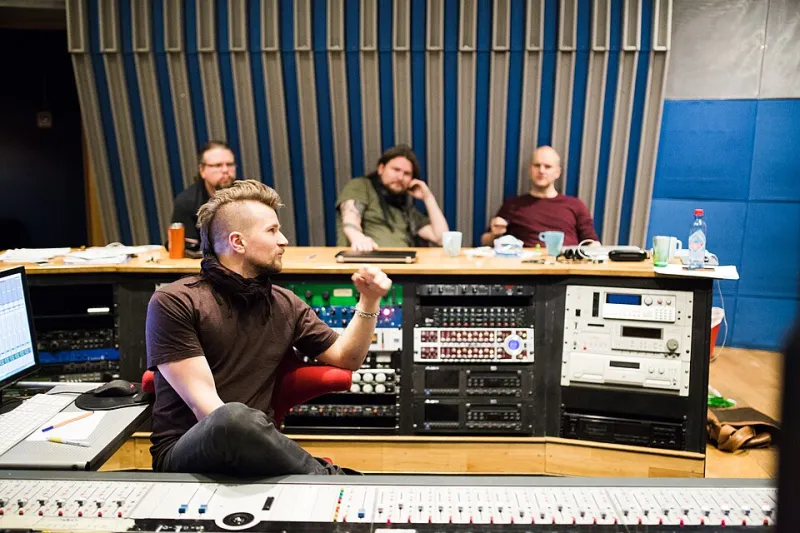
Photo: Cristian Sarbu, CC BY-SA 4.0, via Wikimedia Commons
Pull up almost any emo-trap record from the last three years. Or a certain strain of hyperpop. Or the weirder corners of alternative R&B. Listen closely to the vocals. There's something happening there that traditional mixing engineers would describe, not kindly, as "in the red." The voice sounds pressurized, almost like it's being held down. Transients are gone. Dynamic range is nonexistent. The whole thing breathes with an almost mechanical uniformity — and somehow, it sounds completely intentional.
That's because it is.
Over-compression on vocals has gone from a rookie mistake to a signature aesthetic. And the artists and producers championing it aren't doing it accidentally — they're doing it because it communicates something that a dynamically natural, well-balanced vocal chain simply cannot.
What Over-Compression Actually Does
For the uninitiated: compression is a standard tool in any mix. It reduces the dynamic range of a signal — the gap between the quietest and loudest parts — to make things sit more consistently in a mix. Used traditionally, it's nearly invisible. A well-compressed vocal sounds natural but controlled.
Over-compression is a different animal. Push a compressor hard enough — high ratio, fast attack, heavy gain reduction — and the vocal starts to exhibit some strange behaviors. The natural swell of a sung note gets flattened. Consonants lose their punch. The voice takes on a kind of relentless, almost aggressive evenness. Breathiness gets amplified. Room noise gets amplified. Everything that a "good" mix is supposed to suppress comes crawling back up.
And in certain contexts, that crawling quality is exactly the point.
The Strangled Aesthetic and Why It Resonates
There's an emotional register that over-compressed vocals occupy that's genuinely hard to replicate any other way. Think of Bladee's vocal delivery, or the more extreme ends of Drain Gang's production. Think of certain 100 gecs tracks where the voice sounds like it's being processed through something that barely survived the trip. Or the woozy, pressure-cooked quality of some of Lil Peep's posthumous releases.
These vocals don't sound comfortable. They sound like something being forced through a narrow opening. And that sonic constriction maps, pretty directly, onto the emotional content of the music — anxiety, dissociation, the feeling of being overwhelmed by your own internal noise.
When a vocal is compressed to the point where it loses its natural dynamics, it also loses a certain kind of emotional distance. Everything is equally present, equally insistent. There's no quiet moment, no breath before the impact. It's relentless in a way that mirrors how a lot of younger listeners describe their mental landscape.
That's not an accident. Producers in this space are making deliberate choices about emotional texture, and heavy compression is one of their primary tools for achieving it.
Producers Leaning Into the Red
Talk to producers working in emo-trap and hyperpop-adjacent spaces and you'll hear a consistent theme: the traditional rules of vocal mixing feel like someone else's aesthetic, not theirs. The idea that a vocal should sit "naturally" in a mix, with preserved dynamics and a healthy headroom buffer, is a convention — and conventions are there to be questioned.
Many of these producers are working from a DIY framework that prioritizes feel over technical correctness. If a heavily squashed vocal sounds more emotionally true to the song, then it is the right choice, regardless of what a mixing textbook says. The "wrongness" of the sound is part of its expressive vocabulary.
This approach has also been influenced by the way music is consumed. On earbuds, in the car, through a phone speaker — the nuanced dynamics of a traditionally mixed vocal often disappear entirely. Over-compressed vocals, paradoxically, can cut through those playback environments with more personality than something that sounds perfect on studio monitors.
The Race Toward Audio Fatigue?
Not everyone is enthusiastic about where this is heading. There's a real conversation happening among mixing engineers and producers about whether the industry is collectively sprinting toward a wall.
Audio fatigue is a genuine phenomenon — the ear and brain tire more quickly when exposed to relentlessly compressed, dynamically flat audio. The loudness wars of the 2000s gave us an earlier version of this problem, where mastering engineers were slamming records as loud as possible and the resulting music was genuinely exhausting to listen to for extended periods.
The current vocal compression trend has a different texture to it — it's not exactly the same problem as the loudness wars — but some engineers argue the underlying dynamic is similar. When the aesthetic of "too much" becomes normalized, where does the threshold move next?
There's also a question of whether this trend, like most production trends, will age gracefully. Certain production choices that felt cutting-edge in their moment become sonic markers of a specific era — sometimes in a nostalgic way, sometimes in a way that makes records feel dated almost immediately.
Distortion as Emotional Honesty
Here's the counterargument, though, and it's a compelling one: every generation of popular music has found its own way to use "wrong" sounds to communicate emotional truth. Distorted guitar was noise before it was rock and roll. Clipping drum machines were mistakes before they were the backbone of hip-hop. The sonic language of wrongness has always been one of music's most generative territories.
The over-compressed vocal fits into that lineage. It's a sound that feels broken in a specific, controlled way — and that controlled brokenness is doing real emotional work. It's telling you something about how it feels to be inside a particular emotional experience, not just narrating that experience from a comfortable distance.
Whether it represents artistic evolution or a trend that'll burn itself out is genuinely hard to call right now. But the fact that it's generating this much conversation — among listeners, producers, and engineers — suggests it's touching something real.
The vocals are in the red. And for a lot of people, that's precisely where the feeling lives.