Deliberately Wrecked: Why Underground Producers Are Engineering Mixes That Sound Like They're Falling Apart
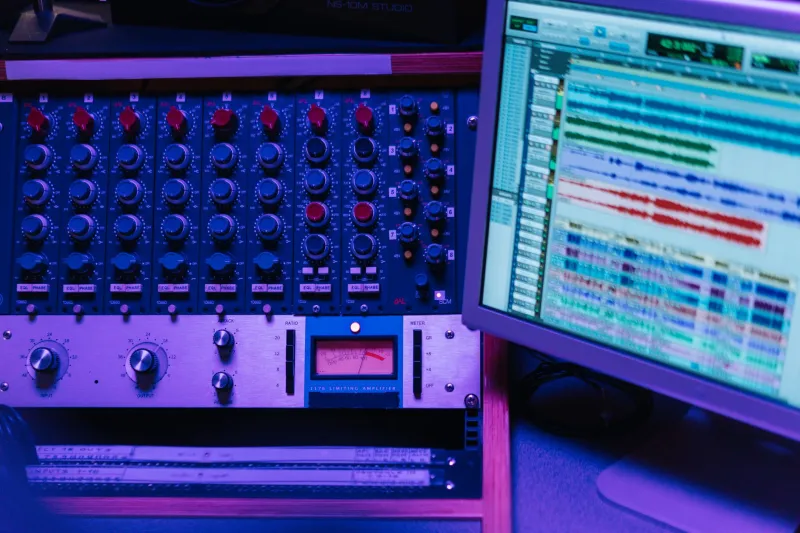
Somewhere between a perfectly mastered major-label single and a cassette that spent six months in a hot car, there's a sweet spot that a certain kind of underground producer has decided to live in permanently. Not because they can't afford better gear or don't understand EQ curves — but because clean, balanced, radio-ready sound has started to feel like a lie.
This is the frequency war. And the producers fighting it are blowing up their own mixes on purpose.
The Backlash Nobody Talked About
For the better part of a decade, the production internet ran on one gospel: get your low-end tight, your mids clear, your highs crisp. YouTube tutorials, Reddit threads, Discord servers — all of it pointed toward the same cathedral of sonic perfection. Reference tracks. LUFS targets. Spectrum analyzers that told you exactly where your mix was sinning.
And for a while, that worked. The tools got democratized, bedroom producers got better, and the gap between a home studio and a professional one started to close in ways nobody predicted.
But something got lost in the translation. A lot of music started to sound... correct. Technically defensible. Emotionally neutral. Like it had been stress-tested and approved by a committee.
The reaction, when it came, wasn't loud. It was muddy. Intentionally.
Phase Issues as a Vibe
Here's the thing about phase cancellation that most mixing tutorials won't tell you: when it happens accidentally, it sounds like a mistake. When it happens on purpose, it sounds like the room is breathing.
Producers working in experimental hip-hop, shoegaze-adjacent bedroom pop, and what some people are loosely calling 'noise-adjacent lo-fi' have started treating phase relationships not as a problem to solve but as a texture to sculpt. Layering slightly detuned copies of the same sample. Running signals through multiple reverbs set to different pre-delay times. Deliberately misaligning drum hits so the kick and the snare are fighting each other in the low-mids.
The result is a mix that feels unstable in the best possible way — like the song is aware of its own impermanence. It's not sloppy. It's anxious. And anxious sounds honest right now.
This ethos has deep roots in Japanese noise music — the kind that came out of scenes in Osaka and Tokyo in the '80s and '90s, where artists like Merzbow and the broader japanoise movement treated sonic destruction as a legitimate art form. That lineage runs straight through the distortion-forward aesthetics that define what we're doing here at Mikunigaoka Fuzz. Broken frequencies aren't new. They're just finding new homes.
Frequency Masking on Purpose
Any mixing engineer worth their invoice will tell you that frequency masking — when two elements occupy the same sonic space and cancel each other's presence — is something you fight. You carve out room with EQ. You sidechain. You separate.
Some producers are doing the opposite.
They're stacking bass and low-mids until everything smears together into a single dense wall. They're letting guitars and pads compete for the same frequency range without arbitration. The result sounds congested in a way that mainstream production has spent millions of dollars learning to avoid.
But congested can feel full. It can feel like the sound is pressing against the speakers from the inside. And in music that's trying to communicate pressure, weight, or emotional overwhelm, that physical sensation isn't a bug — it's the entire delivery mechanism.
Producers in the underground rap space have been particularly sharp about this. When your music is designed to be heard through phone speakers or earbuds on a crowded subway, a mix that's been optimized for a studio monitor setup can actually sound thin and distant. A mix that's been intentionally compressed and muddied can punch through in ways that technically clean production can't.
Tonal Imbalance as Emotional Honesty
One of the stranger trends sitting inside all of this is the deliberate rejection of tonal balance as a goal. Major-label production has a sound — not just in terms of loudness or clarity, but in terms of where the emotional weight of a song sits. Everything is leveled out. Highs don't get too harsh. Low-end doesn't get too oppressive. It's a kind of emotional averaging.
What underground producers are doing is refusing to average. They're letting a mix be too dark, or too bright, or too bass-heavy — and they're not correcting it because the imbalance is the feeling they're trying to communicate.
A track that's too heavy in the low-mids sounds anxious and claustrophobic. A mix that's too bright and harsh sounds exposed and raw. These aren't neutral descriptions — they're emotional states. And if the song is about anxiety or exposure or rawness, then a balanced mix is actually the less honest choice.
This is where the frequency war gets philosophical. It's not just about aesthetics or contrarianism. It's about whether technical correctness and emotional truth are even the same thing. A lot of these producers would argue they're not. A lot of the time, they'd be right.
The Credibility Paradox
Here's the twist that makes all of this genuinely interesting: the moment intentional imperfection becomes a recognized aesthetic, it starts carrying its own kind of prestige. Which means the thing that was supposed to be a rejection of credibility-signaling has become its own credibility signal.
People can hear it now. They can tell when a mix has been deliberately muddied versus accidentally muddied. The intentional version has a coherence to it — the chaos is controlled, the imbalances are consistent, the phase weirdness is everywhere rather than just in one part of the song. It's the difference between a painting that looks unfinished because the artist ran out of time and one that looks unfinished because the artist understood exactly when to stop.
That distinction is the whole game. And the producers who are winning the frequency war are the ones who've figured out that 'broken on purpose' requires just as much craft as 'perfect on purpose' — maybe more.
The mix that sounds like it's falling apart? It took a long time to build it that way.