Scream Architecture: How Producers Are Building Songs Out of Feedback That Was Never Supposed to Exist

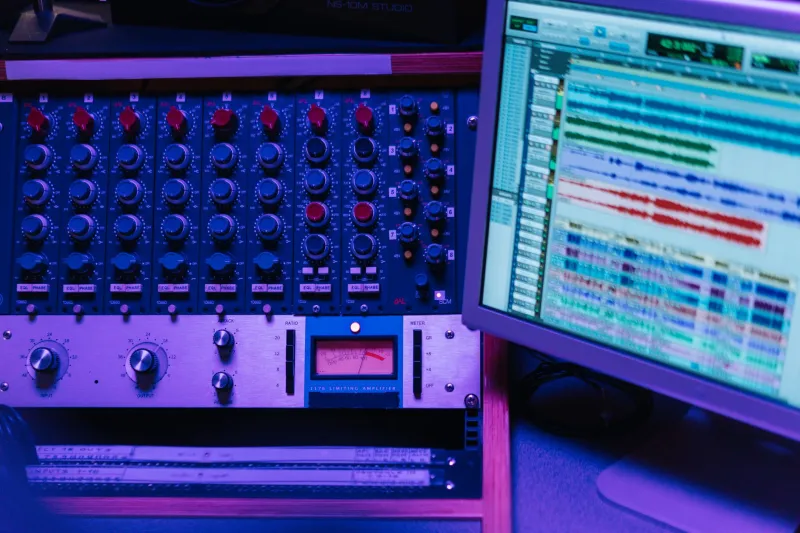
There's a specific kind of dread that washes over a sound engineer when they hear that first high-pitched whine climbing out of a monitor. Feedback. The enemy. The thing you kill immediately, apologize for, and spend the rest of the night avoiding. It means someone pointed a mic at a speaker, or a gain stage got greedy, or some invisible resonance in the room decided to announce itself at full volume.
For a very specific group of producers, that moment of dread is actually the moment the session starts getting interesting.
The Loop That Shouldn't Be a Loop
Feedback is physics. Point a microphone at its own output source — whether that's a speaker, a monitor, or even another microphone — and the signal starts chasing itself. It amplifies, it feeds back into the chain, it amplifies again. Left unchecked, it becomes a runaway screech that can blow speakers and ruin takes. Every recording school teaches you how to prevent it. Almost none of them teach you how to use it.
But here's the thing about feedback that the rule books skip: it has pitch. It has texture. It evolves over time. The frequency it locks onto is determined by the physical space, the gear in the chain, and a dozen other variables that you can actually manipulate if you know what you're doing. That screech isn't random noise — it's the room talking back to itself at a very specific frequency. And once you realize you can move that frequency, control its sustain, layer multiple loops at different pitches, you stop seeing feedback as a problem and start seeing it as an instrument.
That realization is what's driving a genuinely weird and fascinating corner of experimental production right now.
Noise as Notation
The philosophical shift here is real and it matters. Traditional recording operates on a basic premise: the signal path should be clean, the source should be isolated, and anything the environment introduces is contamination. Feedback is the loudest possible violation of that premise. It's the room asserting itself. It's the chain collapsing in on itself. Treating it as a compositional tool means completely abandoning the contamination framework — and deciding instead that the collapse is the composition.
Producers working in this space talk about it almost like tuning an instrument that doesn't want to be tuned. You can coax feedback toward certain frequencies by adjusting room position, mic angle, EQ curves on the monitor, even the physical distance between source and receiver. You can create a feedback loop that sustains at a near-perfect fifth above your root note if you're patient enough and your room cooperates. You can cut the gain right at the edge of the loop's sustain point and get a controlled bloom that sounds nothing like a synth pad but fills the same harmonic space.
The Japanese noise tradition — the Japanoise lineage running from Merzbow through to artists like Hijokaidan — has been working with feedback as primary material for decades. What's new is the way that approach is filtering into hip-hop beat-making, industrial pop production, and avant-garde electronic music aimed at audiences who didn't grow up on noise records. The aesthetic is crossing over, and it's bringing the feedback with it.
The Bedroom Advantage
Here's an irony worth sitting with: the bedroom studio, historically the environment most prone to accidental feedback problems, turns out to be weirdly ideal for deliberate feedback work. Small rooms have strong resonant modes. Cheap gear has gain staging that can be pushed into unstable territory without a lot of effort. Untreated walls reflect sound in unpredictable ways that a professionally deadened studio would eliminate.
All of that is usually a liability. In the hands of someone trying to compose with feedback, it becomes a feature. The room's resonant frequency becomes part of the instrument. The cheap preamp's tendency to get wobbly at high gain becomes a tone-shaping tool. The reflections that a real studio would absorb become part of the feedback's harmonic character.
Producers working this way often describe their rooms as collaborators. You learn where the hot spots are — the spots where a mic will lock into a feedback loop at a predictable frequency. You learn how your specific chain behaves when you push the gain past the point of stability. You develop a physical, spatial understanding of your setup that goes way beyond what any plugin can replicate, because plugins can't feed back into themselves the way a physical room can.
Rhythm in the Screech
Melodic feedback is one thing. Rhythmic feedback is a whole other conversation, and it's where some of the most interesting work is happening right now.
If you interrupt a feedback loop — cut the signal, then restore it — you get a percussive event. The loop collapses and re-establishes itself, and that re-establishment has an attack transient that you can time, sequence, and layer. Some producers are running feedback through gates, using sidechain signals to chop the loop into rhythmic patterns. The result sounds like nothing else: a metallic, resonant stutter that has the tonal characteristics of feedback but the rhythmic behavior of a programmed drum hit.
Others are using feedback as a textural bed that sits under more conventional drum programming, letting the loop breathe and shift while the kick and snare stay locked. The feedback becomes almost like a living room tone — a sustained presence that makes the whole track feel like it's on the edge of losing control, even when everything else is perfectly quantized.
That tension — between the controlled and the uncontrollable — is a big part of the appeal. A track built around feedback has a quality of precariousness that synthesized sounds can't fake. Something in the listener's body recognizes that the sound is genuinely unstable, that it could theoretically keep climbing, and that recognition creates a kind of low-grade physiological unease that producers are absolutely exploiting.
The Anti-Plugin Argument
There are feedback simulation plugins. They exist, they're used, some of them are pretty convincing. But the producers most committed to this approach tend to be dismissive of them, and not just out of some purist reflex. The argument is that simulated feedback lacks the site-specificity of real feedback — the way a real loop is a document of a particular room, a particular chain, a particular moment. A plugin feedback sounds like a feedback. A real loop sounds like your room screaming back at you.
That specificity is part of what makes the technique feel meaningful rather than gimmicky. It's not a texture you downloaded. It's something that happened in your space, with your gear, and you shaped it rather than eliminated it. That's a different kind of ownership.
The Sound That Fought Back
Feedback has always been a power move, even when it was accidental. Hendrix knew it. Sonic Youth built careers on understanding it. The noise artists who turned it into pure material were working with the same fundamental insight: the signal fighting back against the chain is more honest than any signal that behaves itself.
What's happening now is a democratization of that insight. The bedroom producers running feedback loops through trap beats and post-industrial pop structures aren't trying to recreate what Merzbow did. They're asking what it means to let your room talk when you're making music for people who listen on phone speakers and earbuds. What does controlled chaos sound like at that scale? What survives the compression? What carries through?
The answer, increasingly, is the screech. The loop. The thing that was never supposed to be there.
Turns out it was the most honest part of the whole session.